THE QUEEN IS DEAD - Song 9: THERE IS A LIGHT THAT NEVER GOES OUT
January 1987:
THERE IS A LIGHT THAT NEVER GOES OUT, from
the album THE QUEEN IS DEAD, is issued as the A-side of the only Smiths single
ever released exclusively in France. ...
Later in 1987:
The Flame of Liberty Monument - a light that never goes out - is constructed in
France above the underpass in which Diana, queen of hearts, will be killed
ten years later. ...
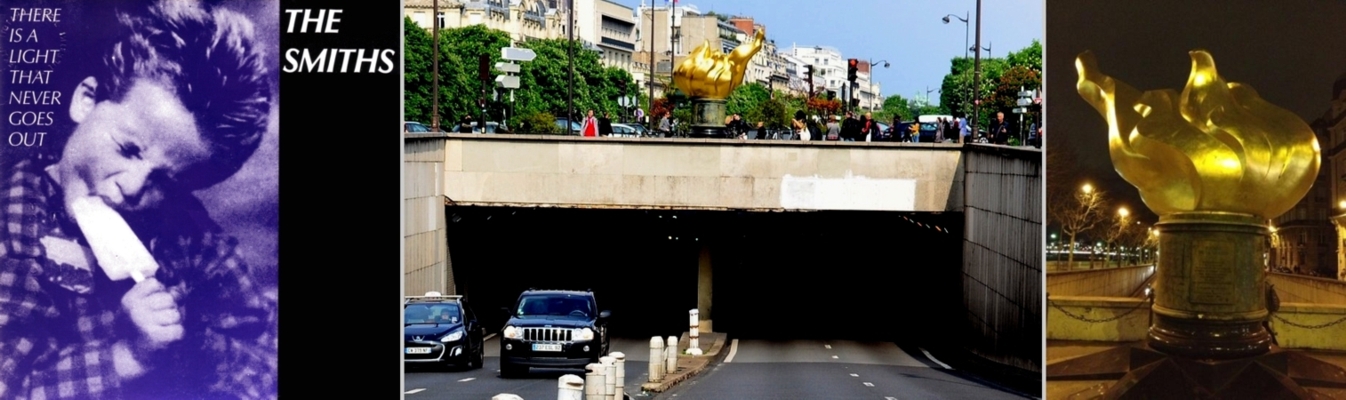
1987: THERE IS A LIGHT THAT NEVER GOES OUT is issued
as the A-side of the only Smiths single ever released exclusively to France.
1987: The Flame Of Liberty Monument is constructed directly above the underpass
in France where Princess Diana will crash ten years later. ...
The Flame Of Liberty
monument - a light that never goes out - became
Princess Diana's unofficial shrine. ...
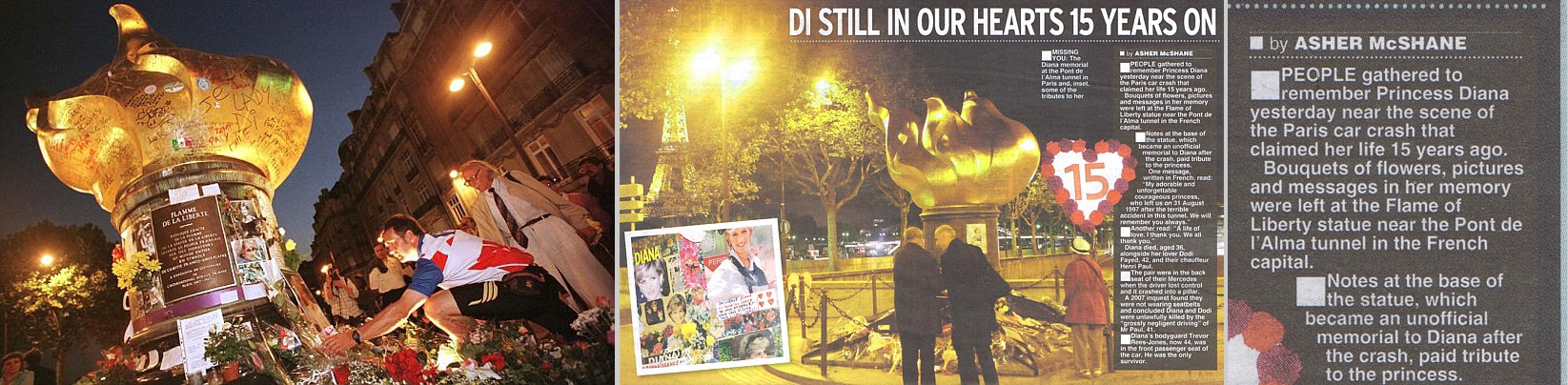
The Flame Of Liberty monument became Princess Diana's shrine
after she crashed in the underpass below it.
On each anniversary of her death, fans pay tribute to
Diana at the "light
that never goes out." ...
Diana crashed beneath the Flame Of
Liberty monument on the night of August 30, the 242nd night of the year. ...
THERE IS A LIGHT THAT NEVER GOES OUT is officially 4 minutes and 2
seconds long, which is 242 seconds. ...

Diana crashed beneath the Flame Of Liberty monument,
"a light that never goes out," on the 242nd night of the year.
The Smiths' song THERE IS A LIGHT THAT NEVER
GOES OUT is 242 seconds long. ...
In the lyrics to the only Smiths
single released exclusively to France:
1 - Two people out on a romantic date, driving at
night in the city. ...
2 - The passenger is no longer welcome at home.
...
3 - The couple fantasize about being killed together in a car
crash. ...
4 - The passenger is gripped by fear in an underpass. ...
5 - The lyrics end by repeating that "there is a light that never goes
out."
Ten years later, Morrissey's lyrics are played out in real
life, in France:
1 - Princess Diana and Dodi Fayed on a romantic date, driving at night in the city. ...
2 - Diana is severely estranged from the royal family. ...
3 -
Diana and Dodi are killed together in a car crash. ...
4 -
Their fatal car crash occurs in an underpass. ...
5 - The
underpass is directly beneath the Flame Of Liberty Monument.

Consistent with Morrissey's lyrics, Princess Diana
and Dodi Fayed are killed together in a car crash while on a
romantic date, driving at night in the city, and the fearful moment
occurs in an underpass.
Princess Diana's severe
estrangement from the royal family was in keeping with Morrissey's lyrics: "oh
please don't drop me home because it's not my
home, it's their home, and I'm welcome no more." ...
The
cover of THERE IS A LIGHT THAT NEVER GOES OUT is a close-up photo of a child
eating a
popsicle. ...
The cover of the 1966 album POPSICLE, by Jan
& Dean, is a close-up photo of a child eating a popsicle. ...
The
child eating the popsicle on the cover of the album POPSICLE is named Carolyn Diane. ...
Carolyn begins with the spelling of the word "Car" and Diane is a variation of Diana. ...
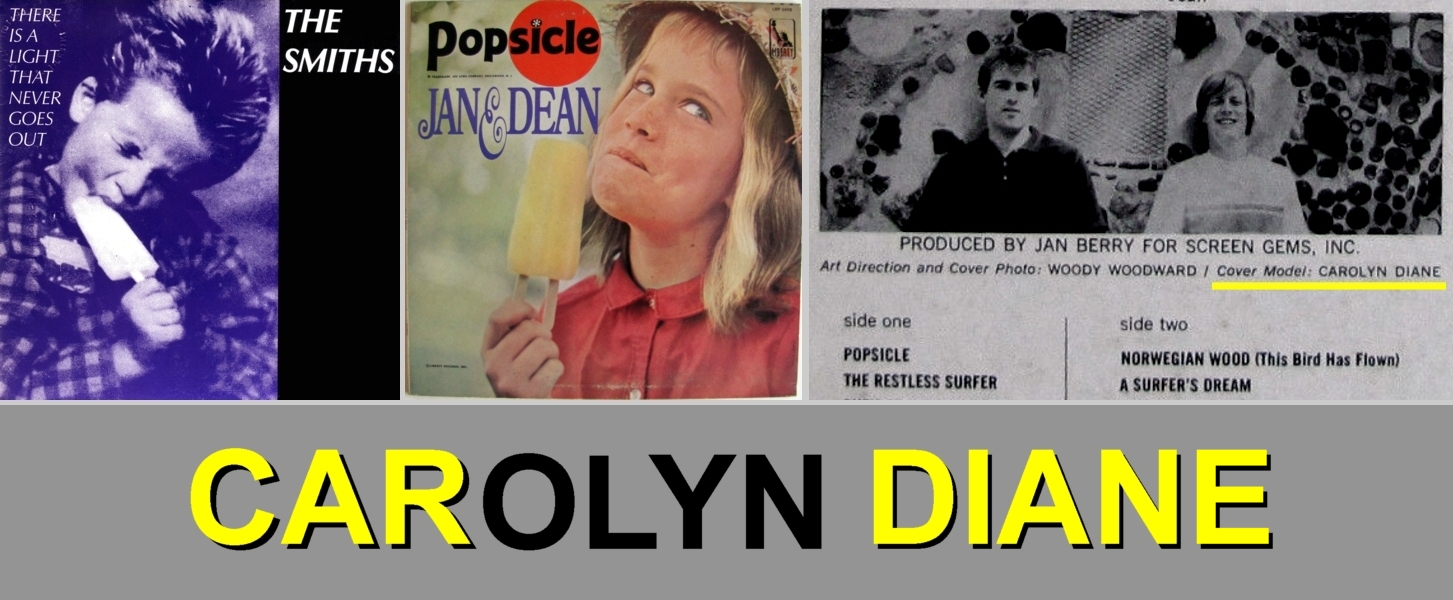
The cover of The Smiths' 1987 single THERE IS A LIGHT THAT NEVER GOES
OUT (released exclusively to France) is a close-up photograph of an anonymous child
eating
a popsicle.
The cover of Jan & Dean's 1966 album
POPSICLE is a close-up photograph of a child eating a popsicle.
She is
Carolyn Diane. Carolyn begins with "Car" and Diane is a variation of Diana. ...
The song-title THERE IS A LIGHT THAT NEVER GOES
is consistent with the Flame of Liberty monument above the
underpass where Diana would be killed in a car crash. ...
POPSICLE was released on
the "Liberty" label, whose logo is the upper section of the Statue of Liberty
holding up the torch replicated by the Flame of Liberty monument. ...
POPSICLE
was the final Jan & Dean album released on the "Liberty" label, and it was
released while Jan Berry (of Jan & Dean) was recovering from a near-fatal car
crash. ...
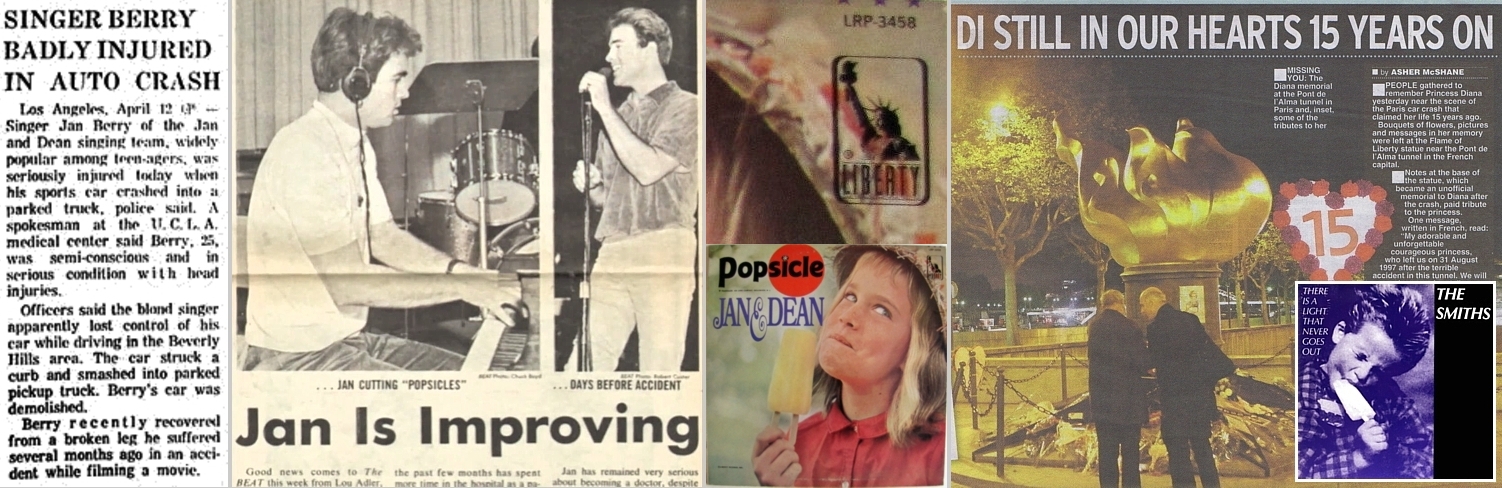
POPSICLE, with Carolyn
"Diane" on the cover, was Jan & Dean's last album on
the Liberty label, whose logo is the torch held high by the Statue Of
Liberty.
It's the same torch replicated
by the Flame Of Liberty monument ("a light that never goes out") directly above
the underpass where Princess Diana will crash.
POPSICLE by Jan & Dean, was released while Jan Berry, of Jan & Dean,
was recovering from his near-fatal car crash suffered weeks
earlier. ...
On the cover of
THERE IS A LIGHT THAT NEVER GOES OUT there is a child eating a popsicle. ...
On the cover
of the 1966 album POPSICLE, by Jan & Dean, there is a child eating a
popsicle. ...
POPSICLE, by Jan & Dean,
was released while Jan was recovering from a near-fatal car crash. ...
The
names "Jan" and "Dean" are comparable to the names "Jayne" and "Diana"
respectively. ...
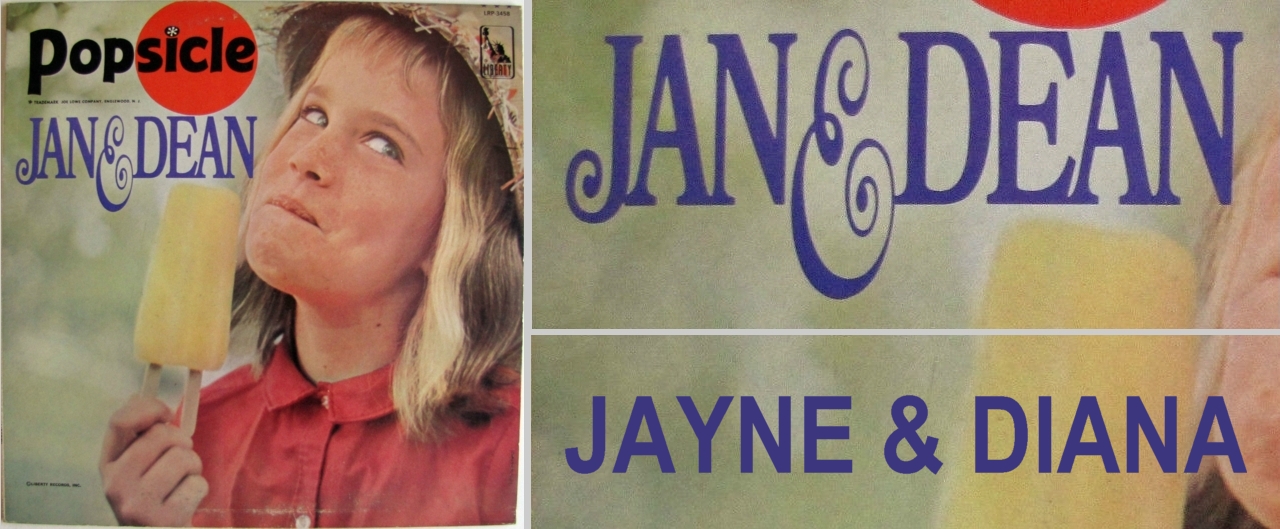
The cover of THERE IS A LIGHT THAT NEVER GOES OUT
has a child eating a popsicle. The cover of POPSICLE, by Jan & Dean, has a
child eating a popsicle.
POPSICLE was released while Jan was
recovering from his near-fatal car crash. The names Jan and Dean are
comparable to the names Jayne and Diana, respectively. ...
In
1967, Jayne Mansfield was killed in her mid-30's (34) in a car crash along with
her boyfriend and their temporary driver for the night. ...
In 1997,
Princess Diana was killed in her mid-30's (36) in a car crash along with her
boyfriend and their temporary driver for the night. ...
Those were the
only two car crashes ever in which the only people killed were a world-famous
woman, her boyfriend and their driver. ...

Actress Jayne Mansfield and Princess Diana were
victims of the only two car crashes in history in which the only three people
killed were a world-famous woman, her boyfriend and their driver. ...
In the poem on back of the album POPSICLE, the only
person identified is Arthur Godfrey, who was born in New York, on August 31. ...
Princess Diana will
suffer her fatal car crash in the underpass that leads directly to the exit to the Avenue de New York, on August 31. ...
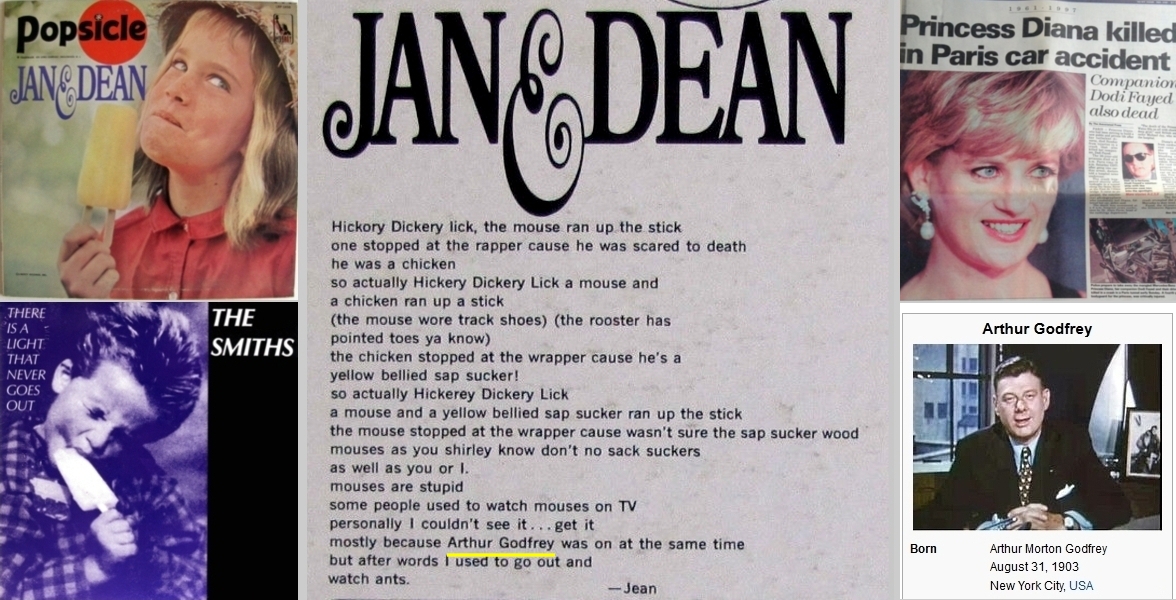
In the poem on the back cover of the album POPSICLE
the only person mentioned is Arthur Godfrey who was born in New York on August
31.
Princess Diana suffered her fatal car crash
in the underpass to the Avenue de New York on August 31. ...
THERE IS A LIGHT THAT NEVER GOES OUT is the
A-side of the only Smiths
single ever released exclusively to France. ...
Princess Diana crashed in
France in the underpass below the Flame of Liberty monument - a light
that never goes out. ...
The B-side of the single THERE IS A LIGHT THAT
NEVER GOES OUT released only to France is titled HALF A PERSON. ...
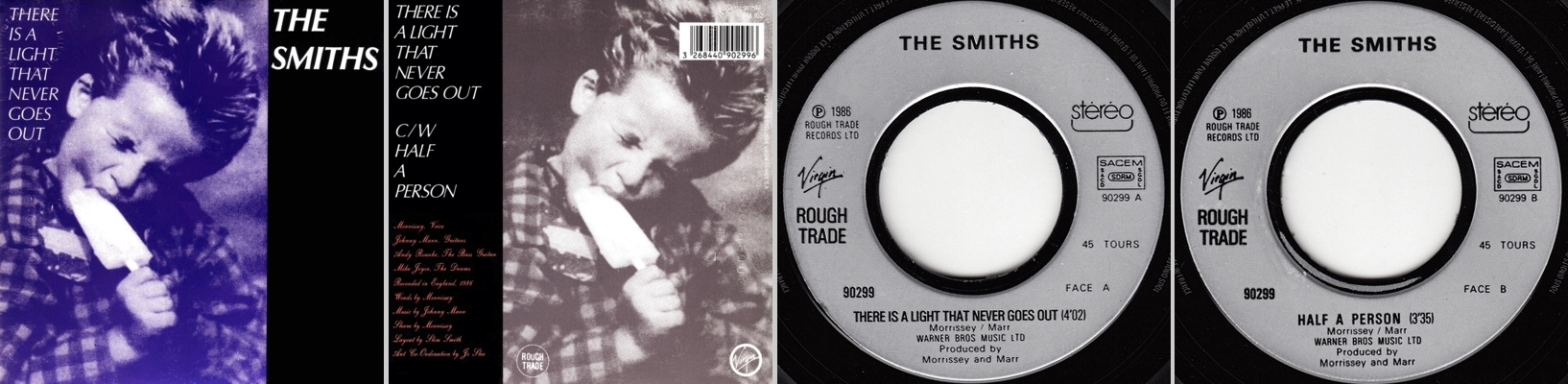
HALF A PERSON is the B-side of the 1987
single THERE IS A LIGHT THAT NEVER GOES OUT, the only Smiths single
released exclusively to France, where Princess Diana will crash beneath the
Flame Of Liberty. ...
The paparazzi had trailed Princess
Diana for years until finally provoking her fatal car crash. ...
The
paparazzi were characterized as ghouls for clamoring to photograph the dying
Princess. ...
HALF A PERSON contains lyrics that are consistent with the
paparazzi's role in Diana's death. ...
HALF A PERSON
Call me morbid, call me pale
I've spent six years on your trail
Six long
years on your trail
Call me morbid, call me pale
I've spent six years on
your trail
Six full years of my life on your trail ...
Call me morbid,
call me pale
I've spent
too long on your trail
Far too long chasing your tail ...
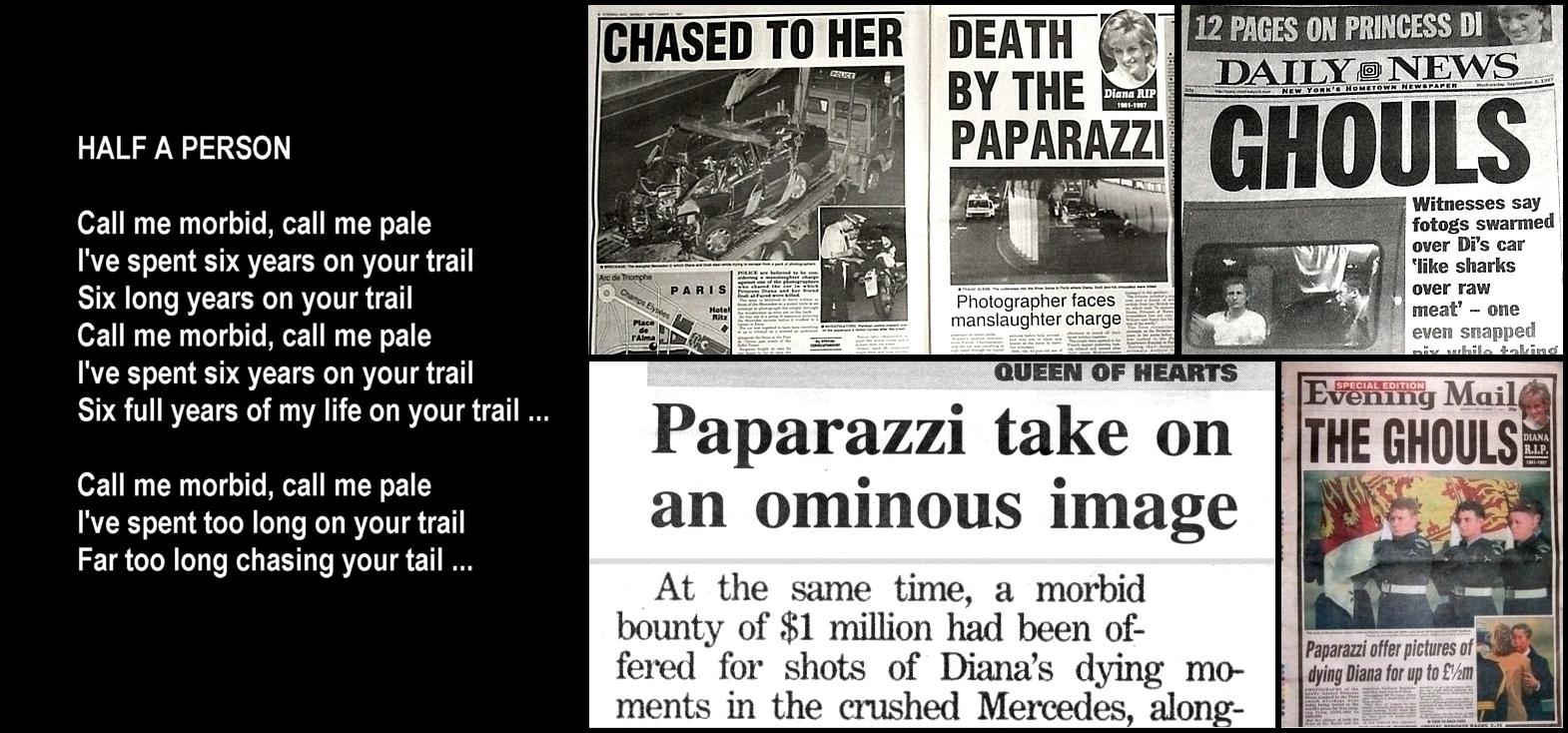
In HALF A PERSON Morrissey
sings, "Call me morbid, call me pale, I've spent too long on your trail, far too long
chasing your tail."
After trailing Diana to her death, the
paparazzi are characterized as "ghouls" for swarming over the dying princess
with their cameras. ...
The only numbers mentioned in HALF A PERSON are
6, 5, and
16:
HALF A PERSON
Call me morbid, call
me pale
I've spent
six
years
On your trail
Six long years
On your trail
Call me morbid, call me pale
I've spent six years on your trail
Six full years of my life on your trail
And if you have five seconds to spare
Then I'll tell you the story of my life:
Sixteen clumsy and shy
I went to London and I ...
In the
Bible, the book of Revelation tells the number of the beast, Satan:
"Here is wisdom. Let him that hath understanding count
the number of the beast:
for it is the number of a man; and his number is Six
hundred threescore and six."
- Revelation: chapter 13
verse18.
“Six hundred threescore and
six” is more famously expressed as 666. ...
The Bible states that the number of
"the beast" Satan is 666. ...
But there is one authentic manuscript that states the number of Satan is
665. ...
And there
are four
authentic manuscripts that state the number of Satan is
616. ...
"According to Aland’s
'The Text of the New Testament'
... over 2300 Greek manuscripts of the New Testament exist today.
Examining Revelation 13:18 in these manuscripts reveals that
there are differences between them. ...
Although the vast majority of
manuscripts give the number of the beast as 666,
four (two pre-sixth century and two no longer existent post-eighth century)
are known to state 616
as the number and
one 11th century manuscript gives 665."
- Dave Novick. ENDTIME MAGAZINE Nov / Dec 2007.
The only three authenticated variations of the number of
Satan are
666, 665, 616. ...
They can all be formed using the only
three numbers in HALF A PERSON:
6, 5, 16. ...
Artists traditionally depict Satan as
being half-man, half-beast. ...
That's consistent with the title of the
song, HALF A PERSON. ...
In 1992, the song THERE IS A LIGHT THAT NEVER GOES OUT was released as a single
again. ...
On the B-side, the song HALF-A-PERSON was replaced with a
song titled HANDSOME DEVIL. ...
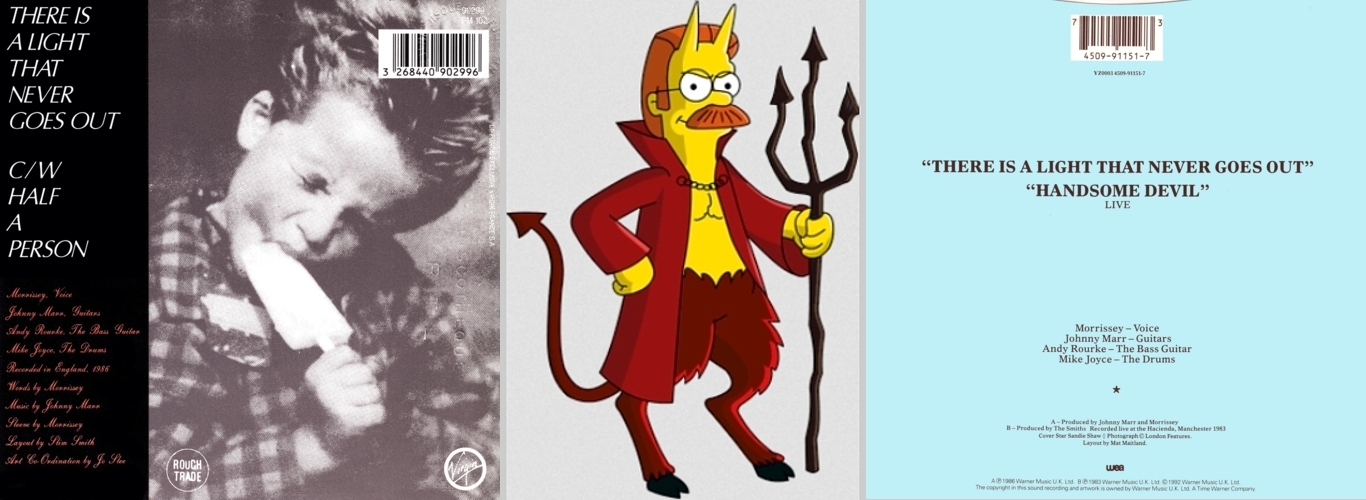
Satan is often portrayed as half-man, half-beast. When THERE IS A LIGHT THAT NEVER GOES OUT was re-released in 1992, the B-side was switched from HALF A PERSON to HANDSOME DEVIL. ...
Diana crashed on the
final day of August, 1997, the month
Morrissey released the album MALADJUSTED. ...
On MALADJUSTED, the title of the last
Morrissey song before Diana's death begins with the word "Satan." ...
Satan Rejected
My Soul
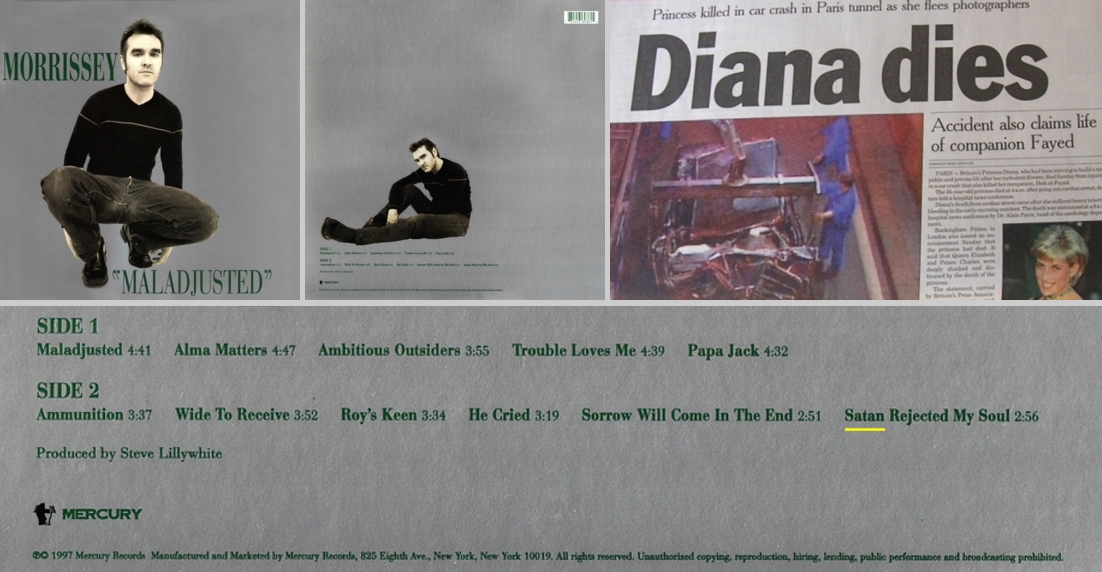
August 1997: On the Morrissey album released in the month Diana
will die, the title of the final Morrissey song before Diana's death begins with
"Satan." ...
In 1967, Jayne Mansfield was killed in her mid-30's (34) in a car crash
along with her boyfriend and their temporary driver for the night. ...
In 1997,
Princess Diana was killed in her mid-30's (36) in a car crash along with her
boyfriend and their temporary driver for the night. ...
Those were
the
only two car crashes ever in which the only people killed were a
world-famous woman, her boyfriend and their driver. ...
Actress Jayne Mansfield and Princess Diana
were victims of the only two car crashes in history
in which the only three
people killed were a world-famous woman, her boyfriend and their driver. ...
The crash that killed Princess Diana uniquely paralleled the
crash that killed actress Jayne Mansfield. ...
The death of Jayne Mansfield was supposedly the fulfillment of a Satanic curse cast by Anton Lavey.
...
Anton Lavey was the founder and leader of The Church Of Satan and the author
of The Satanic Bible. ...
"Jayne lived with awful dread during the last year of her life when she believed
that a curse had been put on her. ...
She traced all her present
difficulties back to the fall of 1966 when she and Sam Brody attended the San
Francisco
Film Festival. At that time a press agent invited the couple to
visit Anton LaVey, the Devil, who was head of a black
magic cult which met
at his home. While there Brody touched a silver chalice and two skulls which
were lying on
LaVey's mantel. Brody had been informed beforehand by the
Devil, as he prefers being called, that a curse had
been placed upon those
objects and that anyone would die as a result of touching them. Brody laughed
and said
he wasn't superstitious. Then the Devil remarked that [Brody] and
Jayne would both be killed tragically and
suddenly within a year. ...
Almost a year later, Anton LaVey called upon Jayne at her fabulous home,
asking if she would don a bikini and pose
with him wearing his Devil
costume, which consisted of a cape and a headpiece with horns, over a robe-like
garment.
He wanted Jayne to pose with the silver chalice and skulls. She
preferred wearing a dress and agreed to the rest, with
a feeling of
obligation to the press agent who arranged the meeting. After this, Jayne,
Brody, and Jayne's children
entertained the Devil and served refreshments.
Five hours later Jayne and Brody were in a car accident which
completely
demolished the brand new Masserati Brody had given Jayne, and which he was
driving. A week later Brody,
while driving his own car, was hit again, and
he suffered a broken leg and ribs. A week later both Jayne and Brody were
killed in a crash on the way to New Orleans.
Now let us recall the
car accidents in a series of three, each spaced seven days apart. I don't know
much about Ju Ju
and Voo Doo, but I do know that exact spaces of time are a
necessary contingent upon the success of curses."
- Evelyn McKeever. SEARCH MAGAZINE. May 1968.
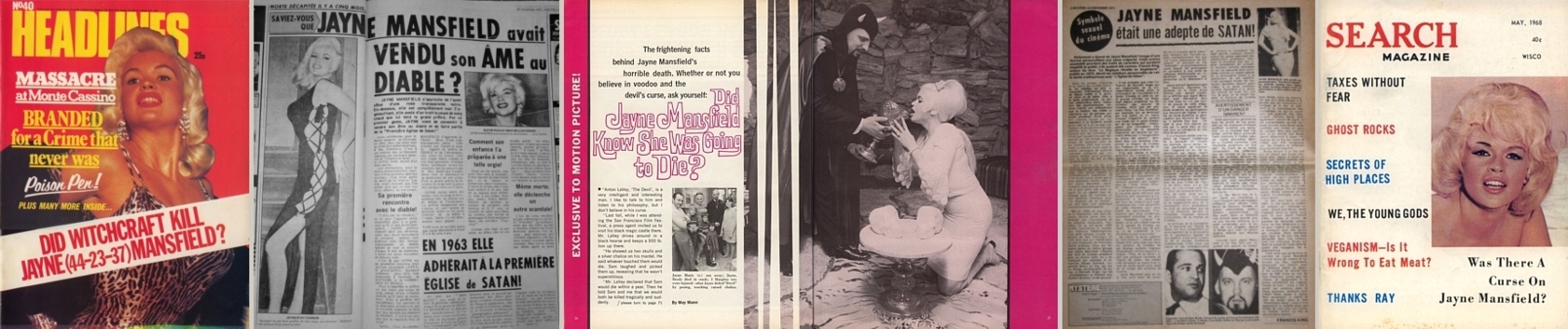
Jayne Mansfield's fatal car crash seemingly fulfilled a Satanic curse cast
by Anton Lavey, the founder and leader of The Church Of Satan, who later
authored The Satanic Bible. ...
Sandie Shaw appears on the cover of
the 1992 re-release of The Smiths' single, THERE IS A LIGHT THAT NEVER GOES OUT.
...
Sandie Shaw's first chart-topping single, in 1964, was
similarly titled, THERE'S
ALWAYS SOMETHING THERE TO REMIND ME. ...

Recording artist Sandie Shaw is on the
front cover of the 1992 re-release of the single, THERE IS A LIGHT THAT NEVER GOES OUT.
In 1964, Sandie Shaw's first hit single was a song
that was
similarly titled, THERE'S
ALWAYS SOMETHING THERE TO REMIND ME. ...
Sandie Shaw is on the
cover of The Smiths 1992 re-release of THERE IS A LIGHT THAT NEVER GOES OUT. ...
In 2013, at the age of 66, Sandie Shaw retired because of a life-threatening car
crash she suffered in France. ...
Princess Diana was killed in a car crash, beneath the Flame Of Liberty, a light that never goes out,
in France.
"Sandie Shaw has revealed that the real reason
behind her decision to retire was a life-threatening car crash in France
earlier
this year. ... Shaw reveals that it was the car
accident that finally made up her mind."
- THE TELEGRAPH. May 28, 2013.
THERE IS A LIGHT THAT NEVER GOES OUT
ended up being the final song on the final Smiths compilation before Princess Diana's
death. ...
The cover of that 1995 compilation -
"SINGLES" - is a photograph of actress "Diana" Dors posing for her
1956 film YIELD TO THE NIGHT. ...
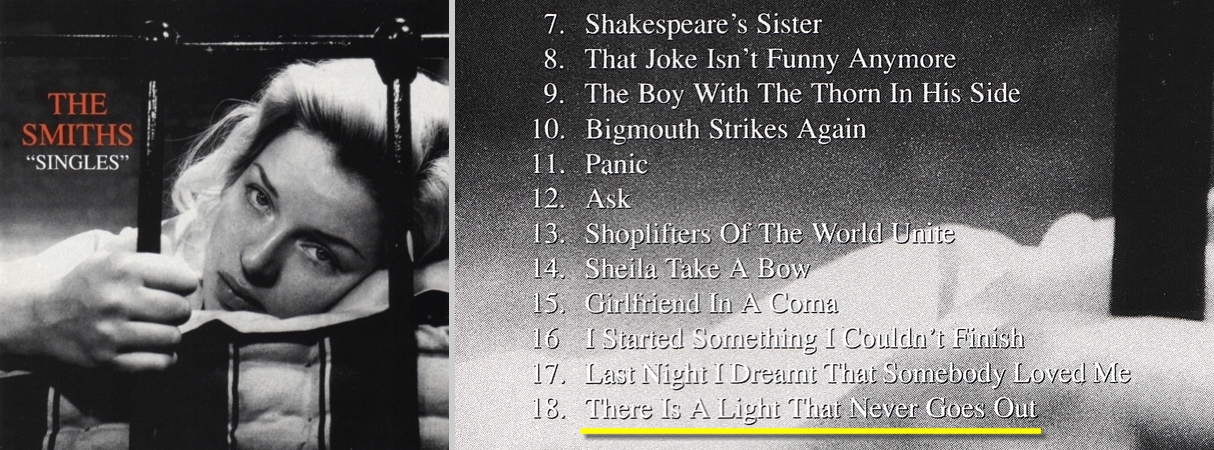
THERE IS A LIGHT THAT NEVER GOES OUT is the final song
on the final Smiths compilation before Princess Diana's death.
The
cover of the 1995 compilation is a photograph of actress Diana Dors posing for her 1956
movie YIELD TO THE NIGHT. ...
YIELD TO THE NIGHT stars Diana Dors
as a convict who is put to death. ...
YIELD TO THE NIGHT premiered in
1956 on May 4. ...
In real life, Diana Dors died in 1984 on May 4. ...
"YIELD TO THE NIGHT was chosen as Britain's
only official entry at the Cannes Film Festival ...
With it's Cannes
premier scheduled for May 4, 1956 ..."
- BRITISH FILM MAKERS: J. LEE THOMPSON. By Steve
Chibnall. Published 2000.
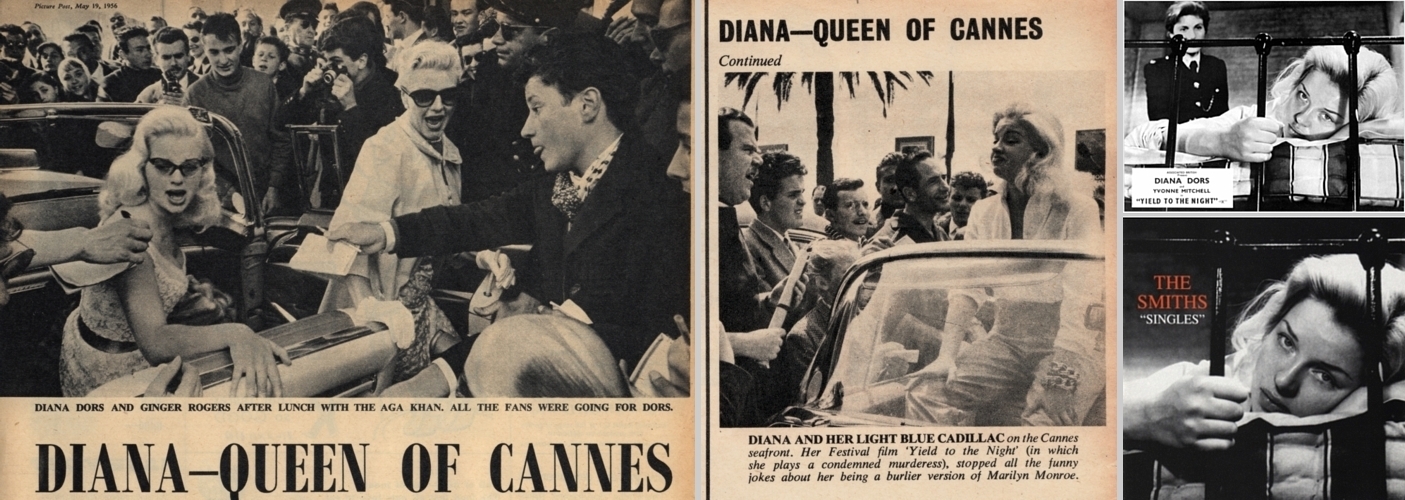
Diana Dors attended the 1956 Cannes Film Festival
where her film YIELD TO THE NIGHT made its world premiere on May 4.
In her
film YIELD TO THE NIGHT, Diana Dors played a woman put to death. In real
life, Diana Dors died in 1984, on May 4. ...
YIELD TO
THE NIGHT starring Diana Dors as a death-row inmate premiered at the 1956 Cannes
Film Festival on May 4. ...
The 1956 Cannes Film Festival went from April 23 to May 10 but the
official poster advertised that it was entirely in
April. ...
It is odd that such a glaring mistake was never corrected. ...
In YIELD TO THE NIGHT, a calender
for April is
used to mark the days until the scheduled death of the inmate played by Diana
Dors. ...
The last date circled on the calendar is April 19. ...
Jayne Mansfield was born on April 19. ...
In April 1967, Diana Dors and Jayne Mansfield posed together for the only time
ever:
"In April 1967 Jayne Mansfield played the once
celebrated and now defunct Batley variety club ...
Among visitors at the club was Mansfield’s British
equivalent Diana Dors, though the American
actress had no idea who Dors was and posed for a
picture with her as if she was just another fan."
- THE BLONDE BOMBSHELL WHO
WENT TO BATLEY by Jane Warren. Express U.K. April 23, 2012.
http://www.express.co.uk/expressyourself/316044/The-blonde-bombshell-who-went-to-Batley
In April 1967, Jayne Mansfield
and Diana Dors posed together with two of Jayne's Chihuahuas. ...
Two months later, Jayne Mansfield was killed in a car crash along with two of her Chihuahuas.
...
"Officers
found two little Chihuahua dogs killed in the crash.
Two other dogs were
found in the car alive and were taken to an animal shelter."
- BOSTON RECORD AMERICAN. June
30, 1967.
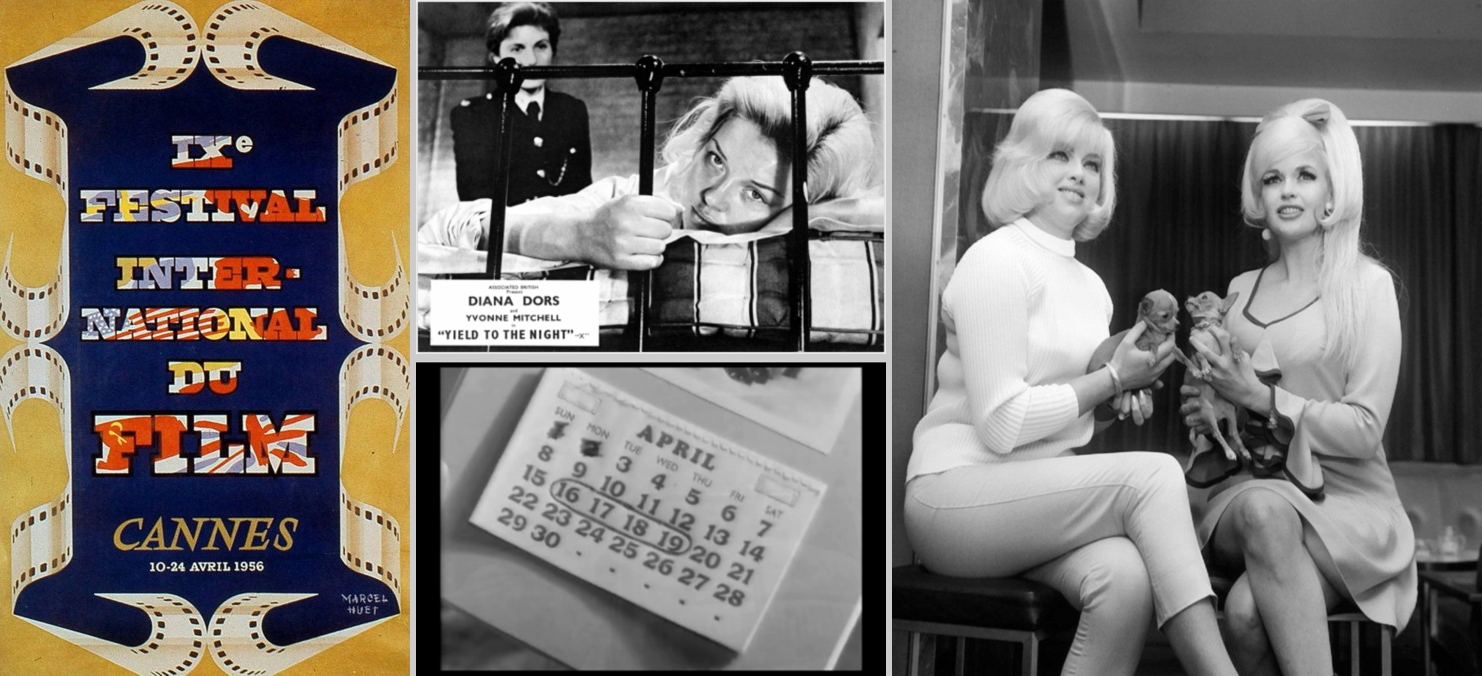
The
official poster says the 1956 Cannes Film Festival was entirely
in April, but it was mostly in May. YIELD TO THE NIGHT premiered in 1956
at Cannes on May 4 - the date Diana Dors will die, in 1984.
In YIELD
TO THE NIGHT, a calendar for the month of April is used to mark the days until the
scheduled death
of the inmate played by Diana Dors. The last date circled is April 19, Jayne Mansfield's
birthday.
In April 1967, Jayne Mansfield and Diana Dors posed
for photos together for the only time, with two of Jayne's chihuahuas. Two
months later, Jayne Mansfield died in a crash along with two of her chihuahuas. ...
YIELD TO THE NIGHT, starring Diana Dors, made its world premiere
at the 1956 Cannes Film Festival. ...
At the 1956 Cannes Film
Festival, Diana Dors posed
poolside for photographs with an inflatable swan. ...
At the
1958 Cannes Film Festival, Jayne Mansfield also posed with one of those same
inflatable swans. ...
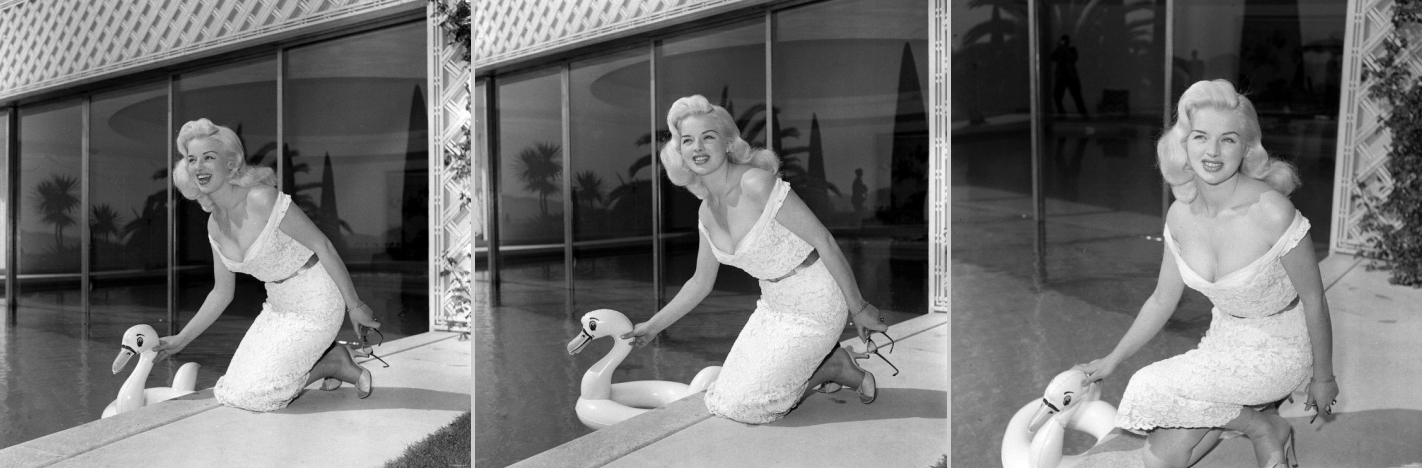
Diana Dors posed for photos with an inflatable swan
at the 1956 Cannes Festival where her film YIELD TO THE NIGHT was making its world premiere.
...
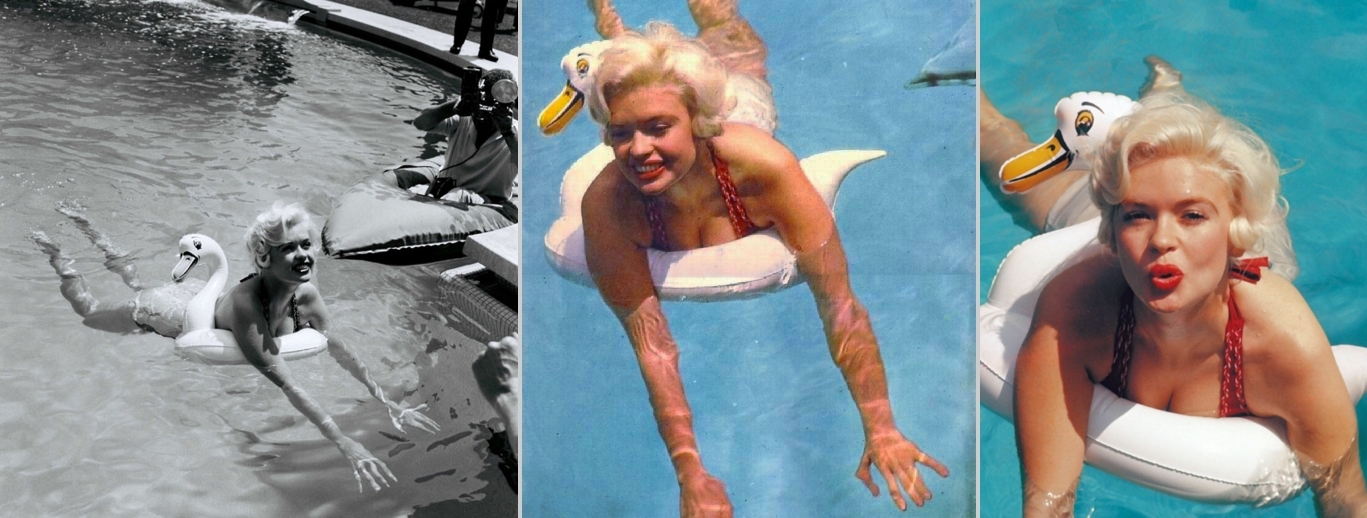
At the 1958 Cannes Film Festival, Jayne Mansfield posed for photos with the
same type of inflatable swan Diana Dors
had posed with two
years earlier at Cannes. ...
An image of Diana Dors and the inflatable swan at
the 1956 Cannes Film Festival is on a vintage trading card that is number 57. ...
However, on the front and back of that vintage trading card number 57, Diana Dors
is incorrectly identified as Jayne Mansfield. ...
When you mark the anniversary
of Diana Dors' death as day 1, the anniversary of Jayne Mansfield's death will
land on day 57. ...

This vintage European trading-card shows actress Diana Dors
at the 1956 Cannes Film Festival, where her film YIELD TO THE
NIGHT premiered on May 4, (the date Diana Dors will die). It is card 57.
The card wrongly identifies Diana Dors as actress Jayne Mansfield. If you
count the anniversary of Diana Dors' death
(May 4) as day 1, the anniversary of Jayne Mansfield's death (June 29) will be day 57.
...
Actress Diana Dors died on May 4. ...
In the film YIELD
TO THE NIGHT, Diana Dors plays a convict who is put to death. ...
Diana
Dors' film YIELD TO THE NIGHT premiered at the 1956 Cannes Film Festival on May
4. ...
The
image of Diana Dors with the inflatable swan (card 57 above) is from the
Cannes Film Festival in 1956. ...
A film titled THE SWAN - starring
Grace Kelly as a fictional princess - made its world premiere in April 1956. ...
In real life, actress Grace Kelly became a princess when she married Prince Rainier
of Monaco in April 1956. ...
In the same week THE SWAN was
released, Grace Kelly's royal wedding was on Jayne Mansfield's birthday. ...
On the vintage card (57) Diana Dors is posed with an inflatable swan but she
is identified as Jayne Mansfield. ...
Jayne Mansfield was an actress
killed in a car crash. ...
Grace Kelly, star of THE SWAN,
was an actress-princess killed in a car crash. ...
Princess Diana was a
princess killed in a car crash. ...
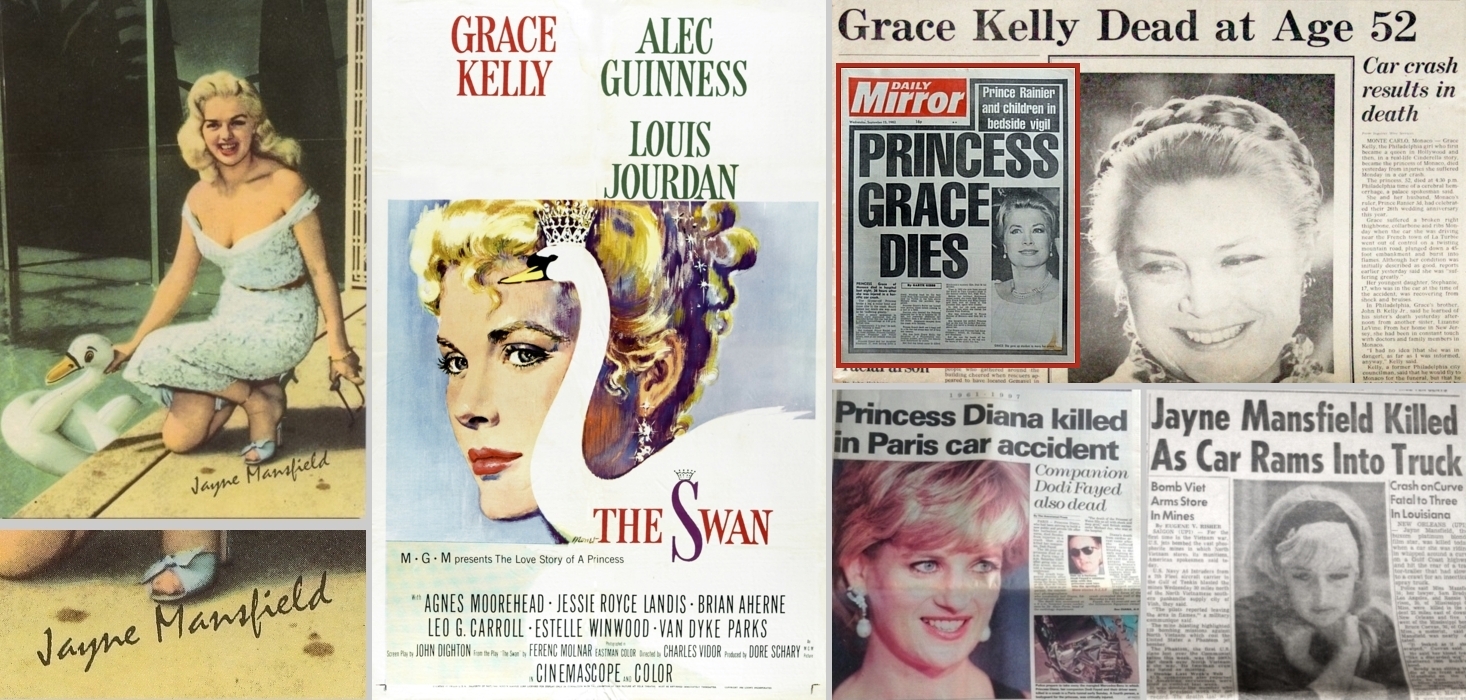
In 1956 Diana Dors posed with an inflatable
swan for the picture on the vintage trading card where she is incorrectly
identified as "Jayne Mansfield." In 1956 actress Grace Kelly played a
princess in the film THE SWAN.
In 1956 Grace Kelly became a real-life
Princess by marrying Prince Rainier of Monaco. Princess Grace had her
lavish royal wedding on Jayne Mansfield's birthday in the same week as the
release of her film THE SWAN.
Jayne Mansfield was an actress killed in
a car crash. Grace Kelly was an actress-princess killed in a car crash.
Diana was a Princess killed in a car crash. ...
57 is the number of the vintage European trading card where Diana Dors is
incorrectly identified as Jayne Mansfield. ...
Card 57 shows Diana Dors at the 1956 Cannes Film Festival where her
film YIELD TO THE NIGHT premiered on May 4. ...
In YIELD TO THE NIGHT
Diana Dors plays a convict put to death while in real-life Diana Dors will die
in 1984 on May 4. ...
On the 57th anniversary of
YIELD TO THE NIGHT's premiere, a
double-decker bus collides with a car on Mansfield Road on May 4.
...
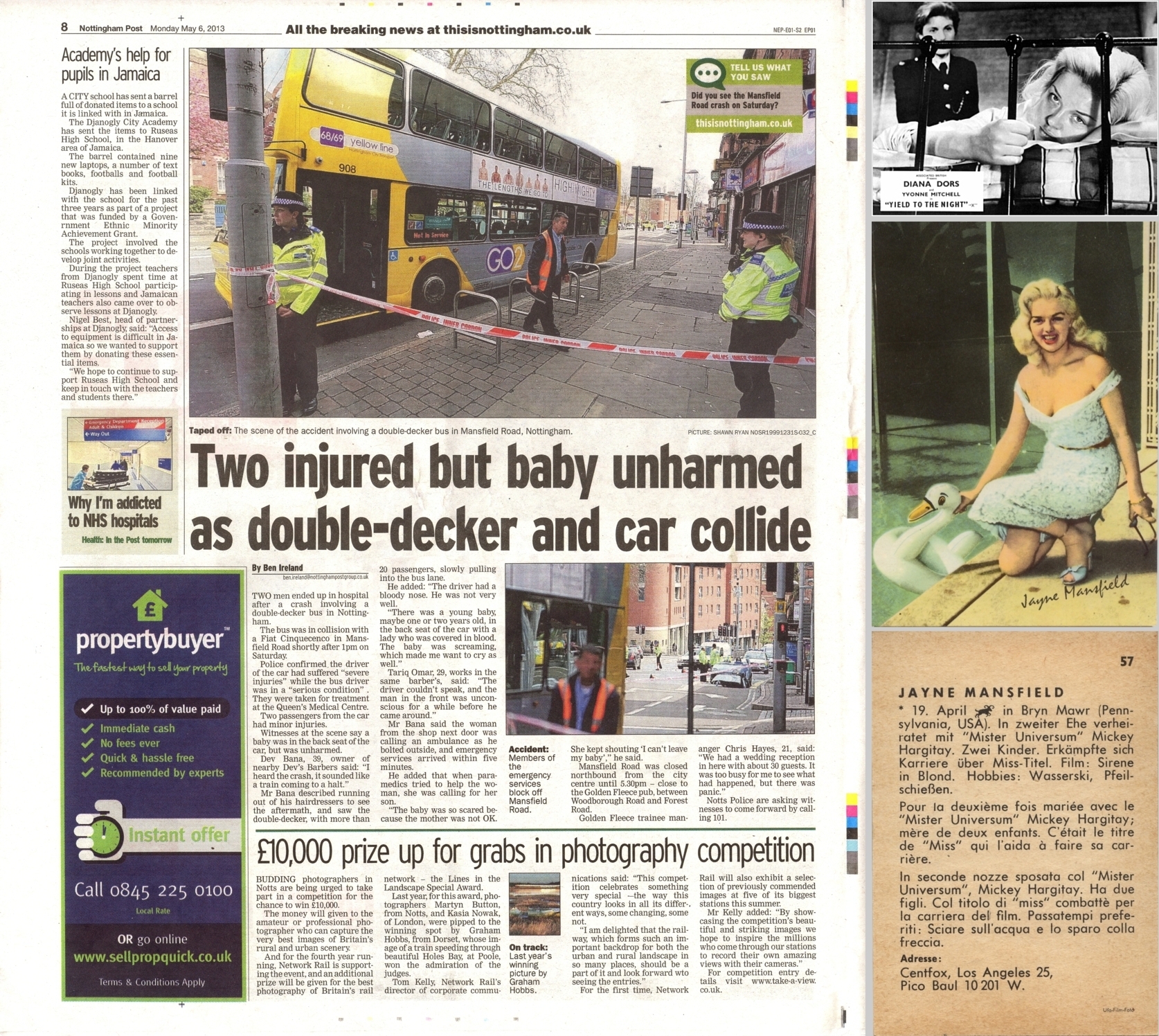
On Saturday May 4, 2013, a double-decker bus collided
with a car on "Mansfield" Road, on the 57th anniversary of the world
premiere of Diana Dors' film YIELD TO THE NIGHT.
The film premiered at the 1956 Cannes Film
Festival where Diana Dors posed for the picture on the
vintage trading card #57 that wrongly identified Diana Dors as Jayne Mansfield. ...
In his chorus to THERE IS A LIGHT THAT NEVER GOES OUT,
Morrissey provides these two examples
of car crashes:
and if a double-decker bus
crashes into us ...
and if a ten ton truck
kills the both of us
The first example, "if a double-decker bus
crashes into us," correlates with the May 4, 2013, crash on Mansfield
Road. ...
The second example, "if a ten ton truck kills the both of us,"
describes the death of Jayne Mansfield and her boyfriend. ...

"And if a double-decker bus crashes into us," happened
on May 4, 2013, on Mansfield Road. "And if a ten ton truck kills the both of
us," happened to Jayne Mansfield and her boyfriend, (lawyer Sam Brody). ...
On Mansfield road, the double-decker bus collided with a Fiat car.
...
"The bus was in collision with a Fiat Cinquecenco
in Mansfield Road shortly after 1 pm on Saturday."
-
Nottingham Post. Monday May 6, 2013
Princess Diana's crash
was triggered by a contact with a Fiat car. ...
"British detectives know a Fiat Uno was involved
because white paint fount on the Mercedes matched
that used exclusively
on models produced between 1983 and 1987."
- DAILY MAIL
online. Last updated September 1, 2007
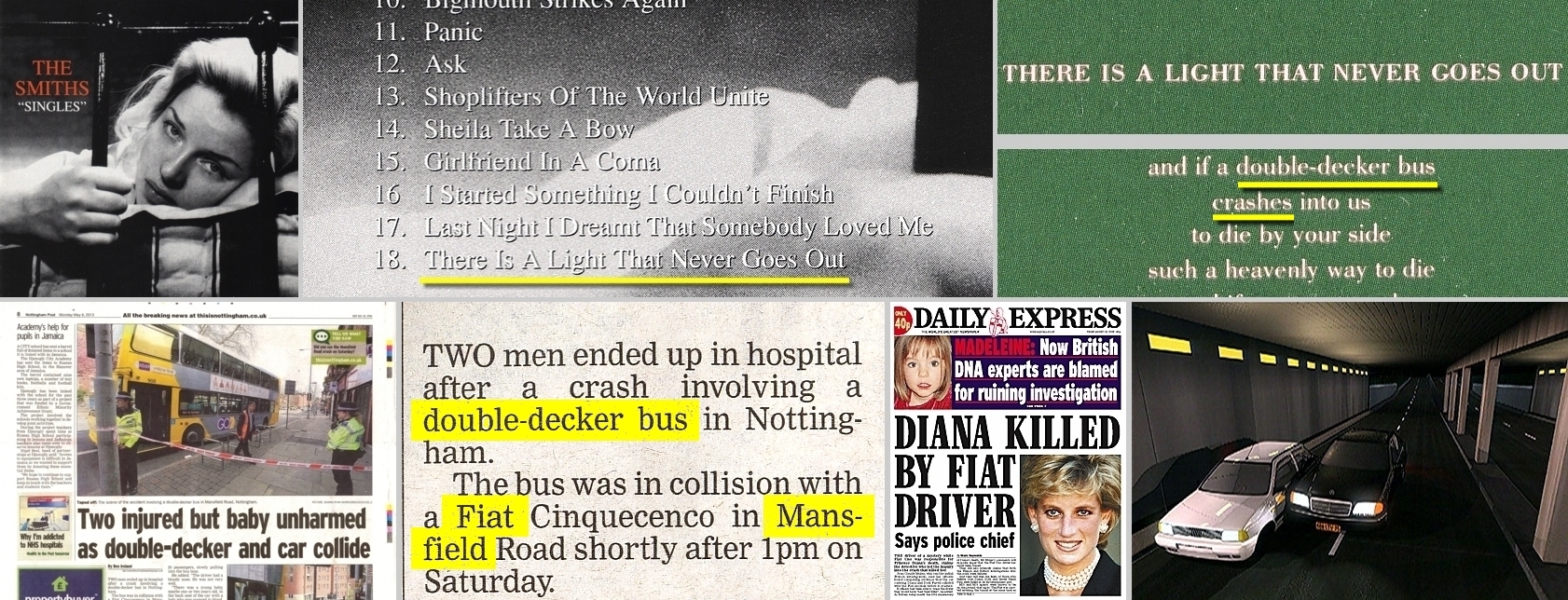
Actress Diana Dors in the film YIELD TO THE NIGHT is on the cover of the last Smiths compilation
released before Princess Diana's death.
The last song on the album is THERE IS
A LIGHT THAT NEVER GOES OUT where the lyrics say, "if a double-decker
bus crashes into us."
In 2013, on the anniversary of Diana Dors'
death and anniversary of the premiere of YIELD TO THE NIGHT, a double-decker bus collided with a
Fiat on Mansfield road.
Evidence indicates that Princess Diana's fatal crash
was triggered by contact with a Fiat in the underpass
beneath "a
light that never goes out" (Flame Of Liberty monument).
Princess
Diana and Jayne Mansfield were victims of the only two car crashes ever in which the only three
deaths were a world-famous woman, her
boyfriend and her driver. ...
THERE IS A LIGHT THAT NEVER GOES OUT was A-side of the only
Smiths single ever released exclusively to France. ...
Princess Diana
crashed in France in 1997 below "a light that never goes out" (the Flame of
Liberty monument) in Paris. ...
In 2009, Morrissey
released his only song ever with a title mentioning "PARIS" and it was issued
as the A-side of a single:
I'M THROWING MY ARMS AROUND PARIS
Morrissey's only song with "PARIS" in the title was released on the A-side of a single
whose
B-side refers to a death:
DEATH OF A DISCO
DANCER.
Consider the first ten letters in the title of the song
on the B-side of Morrissey's only song whose title refers to "PARIS":
DEATH OF A DI
Diana
was routinely referred to as Lady "Di" or Princess "Di" which makes her fatal crash in
"PARIS"
a "DEATH OF A DI." ...
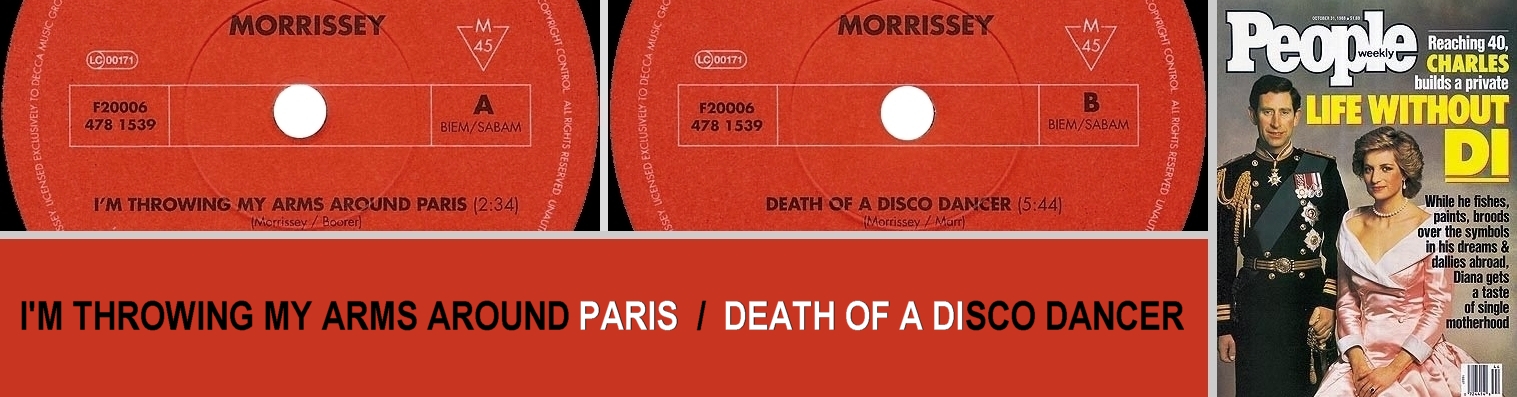
Princess Diana was routinely referred to as "Di"
and she was killed in Paris, in 1997. In 2009 Morrissey released a single
whose title ends with the word "PARIS." On the B-side, the first ten
letters in the title say "DEATH OF A DI." ...
The vinyl single I'M THROWING MY ARMS AROUND PARIS, backed
with DEATH OF A DISCO DANCER, includes an inner sleeve. ...
On the inner sleeve there is a photograph of Morrissey posing with the men in his band and everyone in the photo
is standing naked. ...
On the side of the double-decker bus
that collided with a Fiat on Mansfield Road, all the men in the advertisement are standing
naked. ...
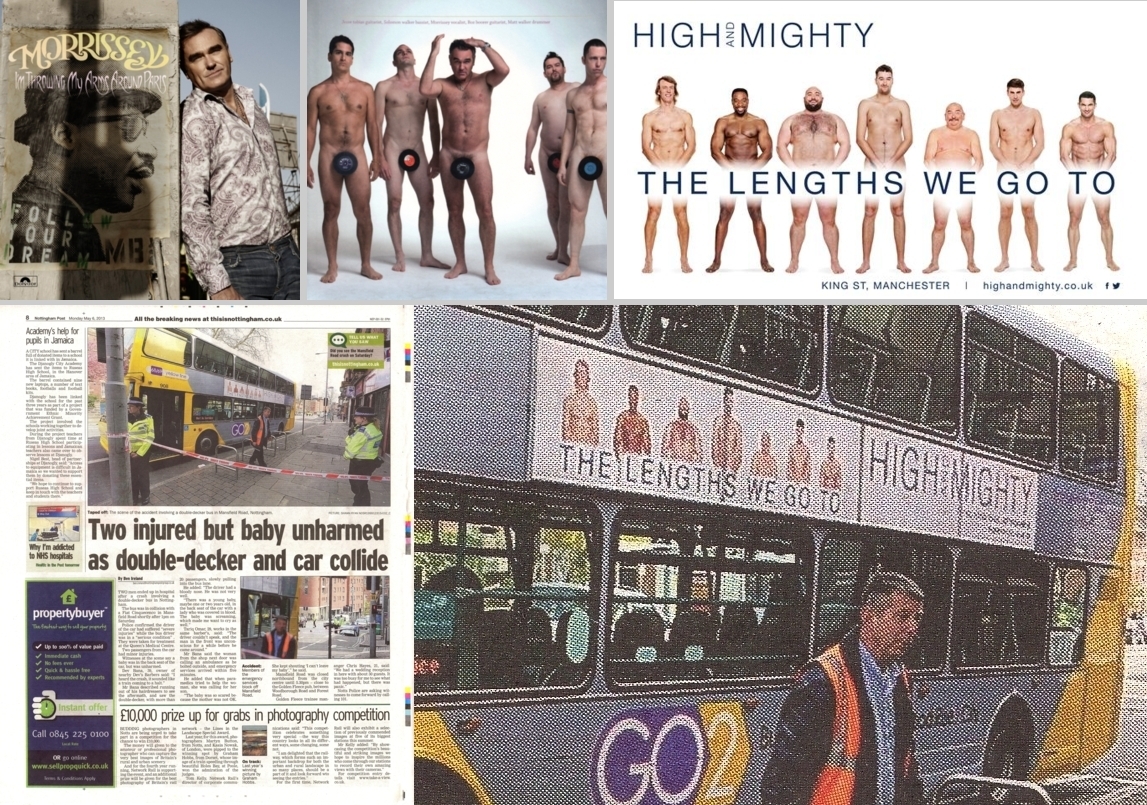
In 2009, Morrissey and his band are photographed
standing naked for the inner sleeve of the single, I'M THROWING MY ARMS AROUND
PARIS.
In 2013, a new advertising campaign features a row of men
standing naked. The ad appears on the double-decker bus that crashed on
Mansfield Road. ...
The only Jayne Mansfield movie that was released after her death (June 29, 1967)
was SINGLE ROOM FURNISHED. ...
A short version of the film had a
very limited release in 1966, but the
full-length version was not released until 1968. ...
"Single Room Furnished was pieced together with a new subplot and
released in 1968, but all Jayne's footage was filmed in 1965 and 1966."
- DID SUCCESS SPOIL JAYNE MANSFIELD? Frank Ferruccio.
2010.
SINGLE ROOM FURNISHED begins with reporter Walter Winchell
announcing the real-life death of Jayne Mansfield. ...
"You are about to see SINGLE ROOM FURNISHED, the new
motion picture starring Jayne Mansfield in her last, and in my opinion, her finest performance. ...
When she completed this picture, a tragic
accident took Jayne Mansfield to another stage."
- Walter Winchell. Introduction to SINGLE ROOM FURNISHED.
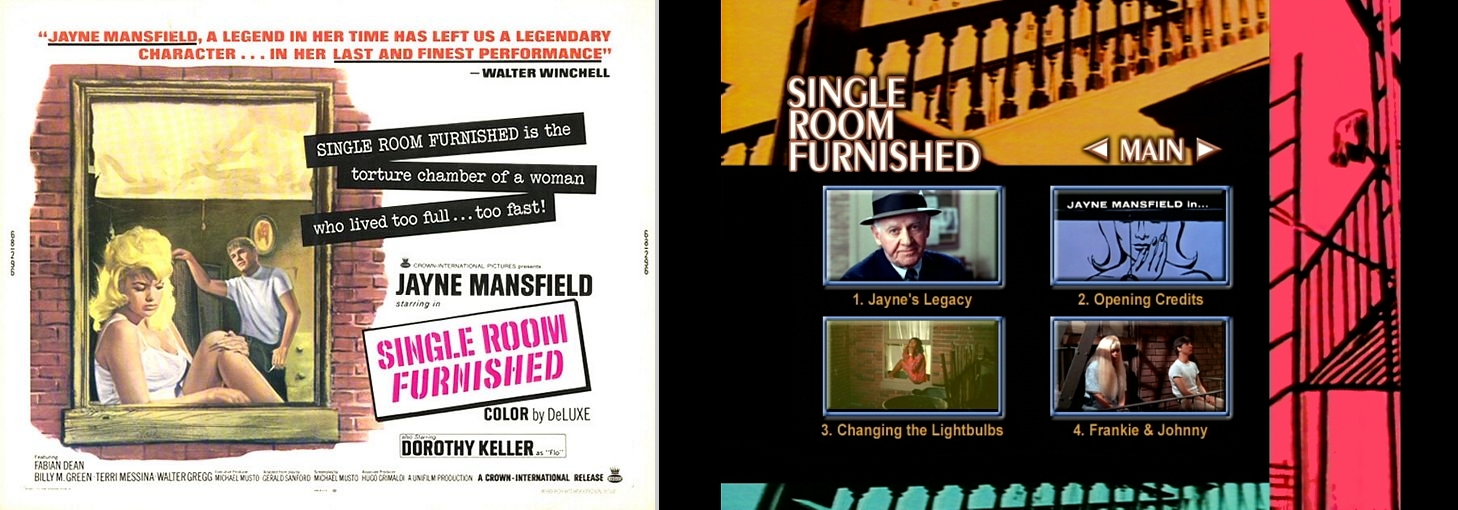
SINGLE ROOM FURNISHED is the only Jayne Mansfield
film
released after her death. It begins with an announcement of her death, by
celebrity reporter Walter Winchell. ...
SINGLE ROOM FURNISHED is the only Jayne Mansfield film released
after her death. ...
The final scene includes Jayne Mansfield's face
superimposed over a white toy duck. ...
The white toy duck resembles the inflatable
swan on the vintage trading card (57) where Diana Dors is identified as Jayne
Mansfield. ...
The card shows Diana Dors holding an
inflatable swan at the 1956 Cannes Film Festival, where her film YIELD TO THE
NIGHT premiered on May 4. ...
In YIELD TO THE NIGHT, Diana Dors
is a convict scheduled to die on Jayne Mansfield's birthday, while in reality Diana Dors died
in 1984 on May 4.
...
Beginning in ancient Greece, swans have had a
mythological association with death, widely known as the "swan song." ...
The myth
of the "swan song" is that swans sense
when they're about to die, and that's the moment they sing their best. ...
"And you take me, it seems, to be inferior in the gift of foresight to the
swans;
which, as soon as they feel that they must die, sing then
louder and better
than they have ever sung in all of their past lives, for joy
they are about to
depart into the presence of the God whose servants
they are..."
- Socrates. PLATO'S PHAEDO.
360 B.C.
SINGLE ROOM FURNISHED begins with reporter Walter
Winchell introducing it as Jayne Mansfield's "last" and "finest
performance." ...
"You are about to see SINGLE ROOM FURNISHED, the new
motion picture starring Jayne Mansfield in her last, and in my opinion, her finest performance. ...
When she completed this picture, a tragic
accident took Jayne Mansfield to another stage."
- Walter Winchell. Introduction to SINGLE ROOM FURNISHED.
The final scene has Jayne Mansfield's face
super-imposed over a white toy duck resembling the white, inflatable swan at
Cannes. ...
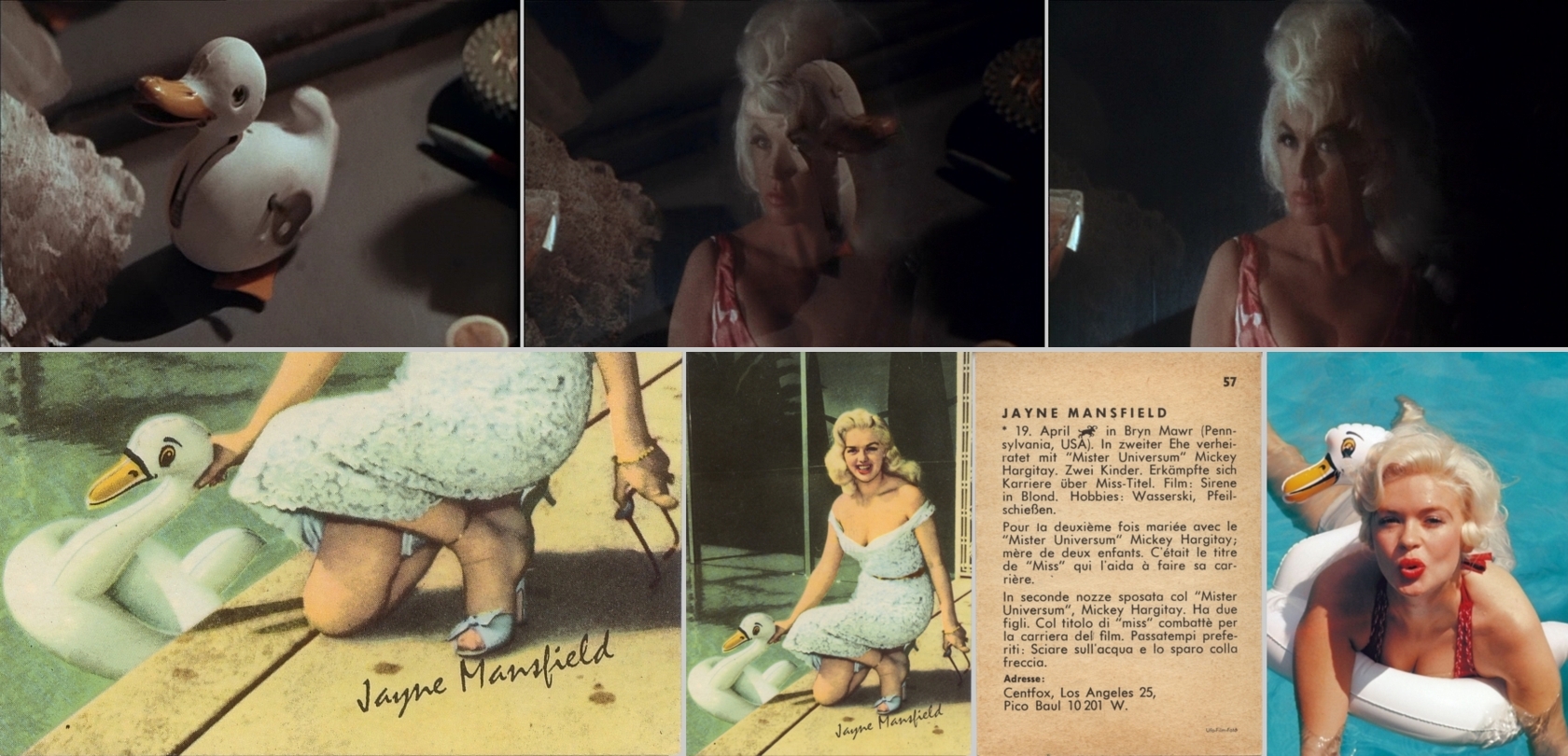
In the closing scene of the only Jayne Mansfield film (SINGLE ROOM
FURNISHED) released after her death, Jayne's face is superimposed over a white
toy duck.
The white toy duck resembles the white inflatable swan on that vintage European trading card
(57) where Diana Dors is incorrectly identified as Jayne Mansfield. ...
Before the
final version of SINGLE ROOM FURNISHED was released, Jayne Mansfield died
crashing into a truck whose driver was from Pensacola, Florida. ...
Pensacola is
home to the Naval Air Training Center whose mascot resembles the toy duck in
SINGLE ROOM FURNISHED and the inflatable swan at Cannes. ...
The
Pensacola mascot is
named
"Jay" Gosling. That's "Jay" as in "Jayne."
...
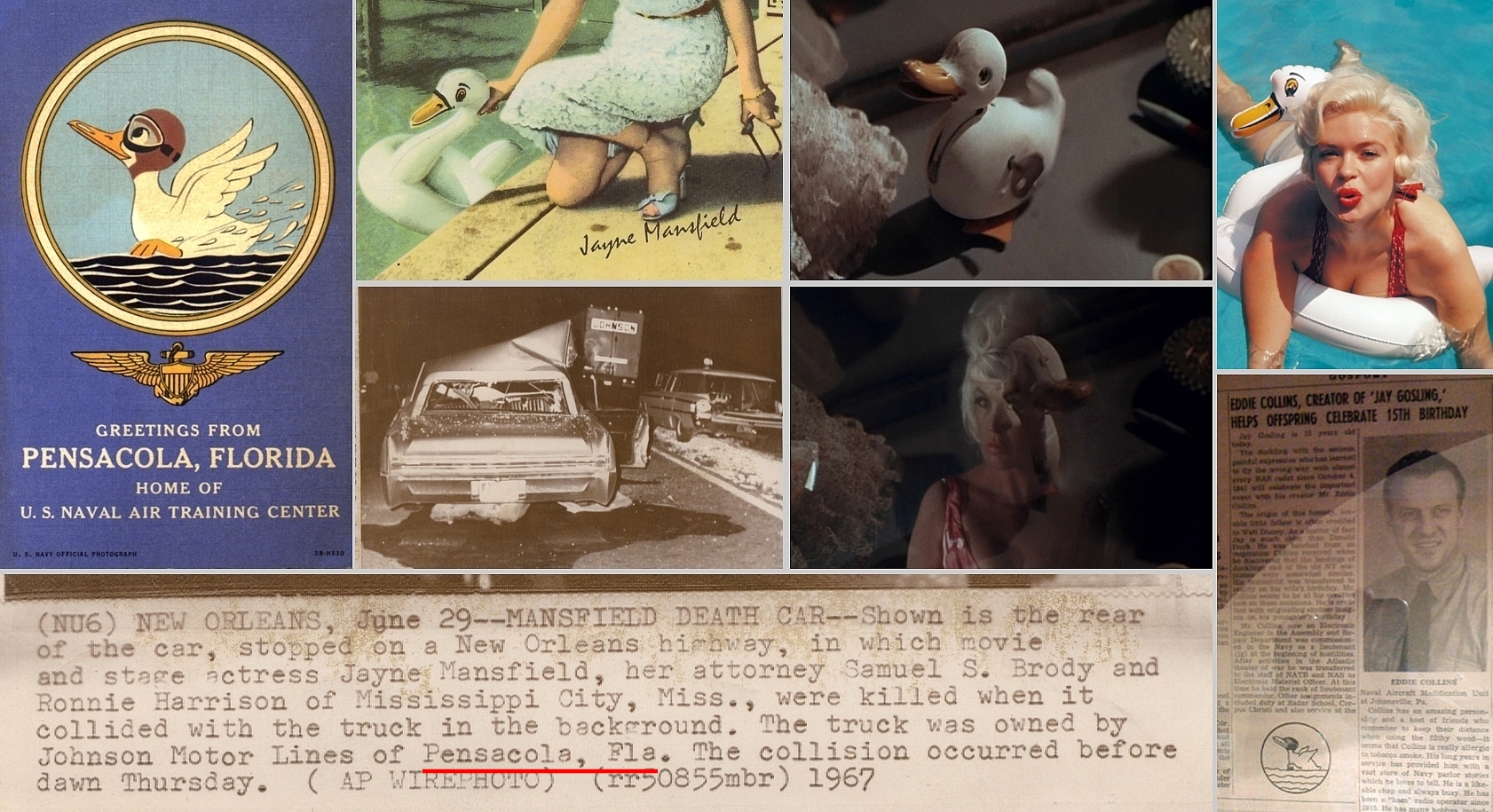
Jayne Mansfield died crashing into a truck from Pensacola,
Florida, home
of the Naval Air Base whose mascot resembles the inflatable swan on the vintage
trading card (57) that incorrectly identified Diana Dors as Jayne Manfield.
The Pensacola mascot
also resembles the white toy duck superimposed over
Jayne Mansfield's face in the final scene of the only Jayne Mansfield film
released after her death. The mascot is "Jay" Gosling.
That's "Jay" as in Jayne. ...
Jayne Mansfield and her boyfriend were killed crashing into the rear of a
truck from Pensacola, Florida. ...
"Jay" Gosling, the cartoon mascot of
the Pensacola Naval Air Training Center, wears an aviator's cap. ...
The
Jayne Mansfield film, THE FAT SPY, released one year before Jayne's death, was
filmed in Florida. ...
In THE FAT SPY, Jayne recites a line that
foreshadows her real death, while she wears an aviators
cap:
Jayne: Now,
if I can just execute a Von Richthofen triple-8 we'd be able to glide in.
Boyfriend: And if not?
Jayne: If not, we'll end up in a
disgusting crash!
One
year
after the release of THE FAT SPY, Jayne Mansfield and her real-life
boyfriend
actually "end up in a disgusting
crash."
...
Their crash is uniquely "disgusting" because of the gruesome reports
that Jayne Mansfield's head was cut off in the collision. ...
"Several TV and radio commentators speculated
on whether the head had been sewed back on.
There were other equally
sickening worldwide reports and comments."
- "JAYNE MANSFIELD - A BIOGRAPHY".
By May Mann. Published 1973.
"The face that was known the world over was completely severed from the body
that made her world-famous. It was the
most dreadful sight
anyone
had ever seen."
- MOTION PICTURE Magazine. September
1967.
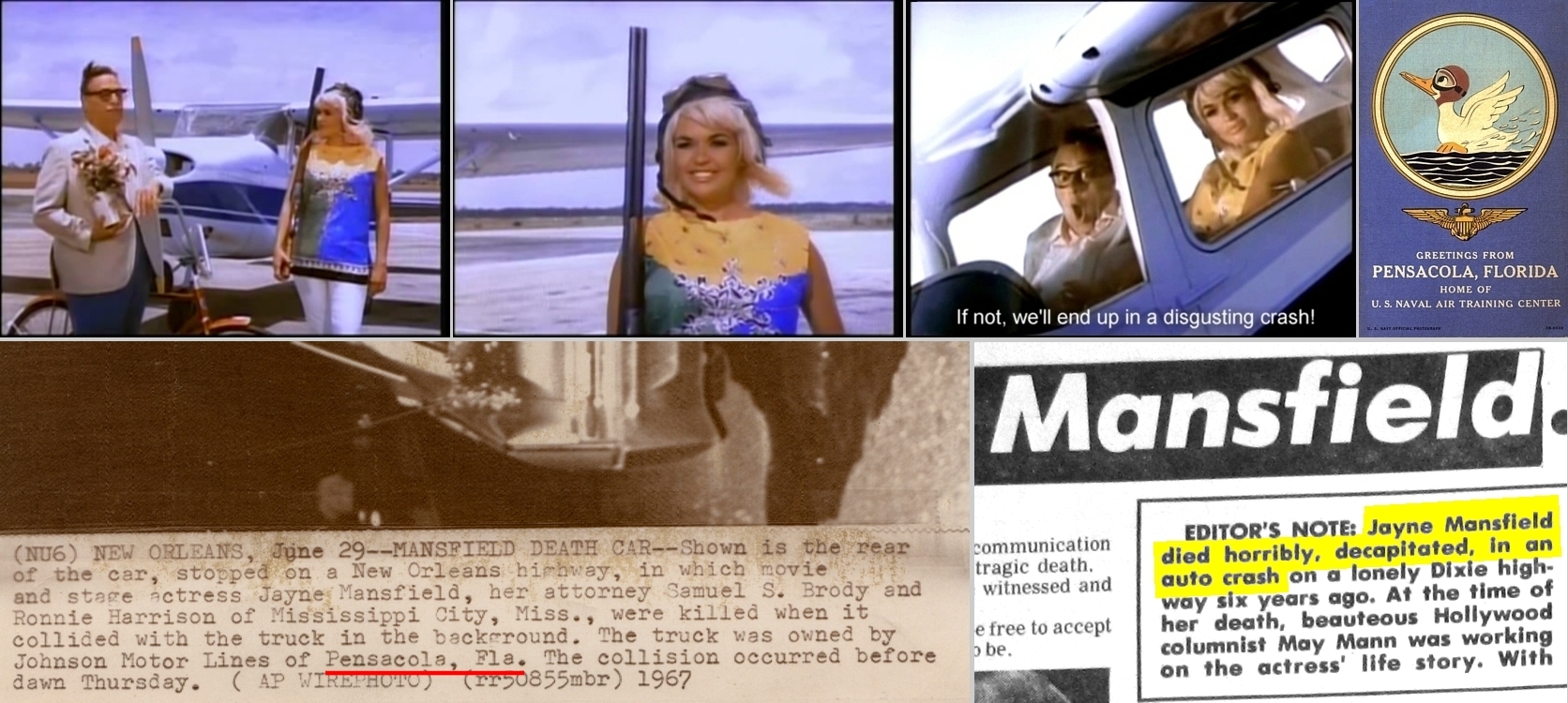
In her 1966 movie THE FAT SPY - filmed in Florida - Jayne Mansfield is piloting a
plane and wearing an aviator's cap when she recites the prophetic words, "we'll end up in a disgusting crash," to
her on-screen boyfriend.
A
year later, Jayne Mansfield and her real-life boyfriend were killed crashing
into a truck from Pensacola, Florida. It was a particularly "disgusting"
crash due to the gruesome reports that Jayne Mansfield was decapitated.
The cartoon mascot from the Pensacola Naval Air
Training Center wears an aviator's cap and is named "Jay" Gosling. That's
"Jay" as in Jayne.
THE DIANA-MORRISSEY PHENOMENON